

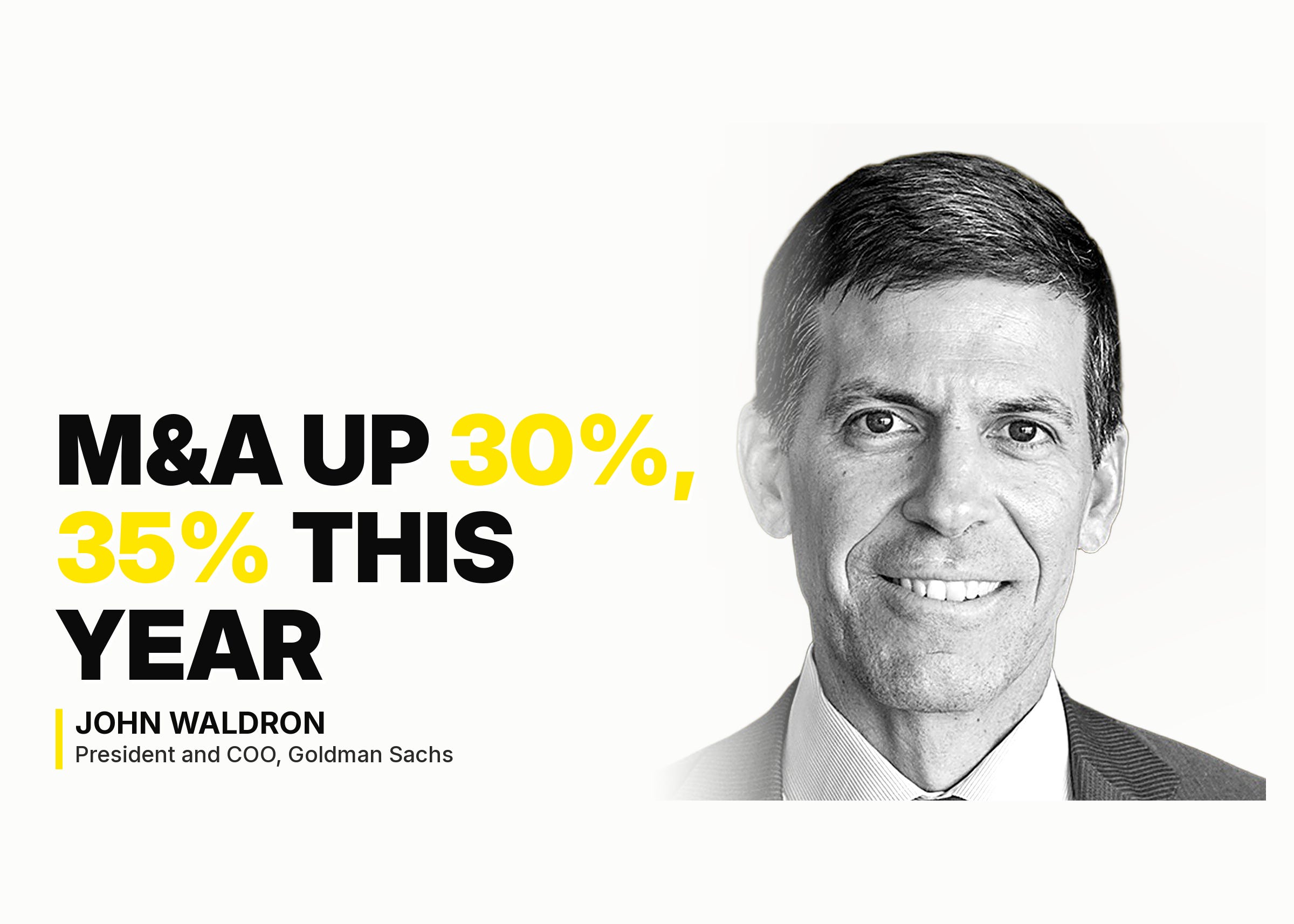
Corporate mergers and acquisitions could rise 30% to 35% this year and set a record, John Waldron, Goldman Sachs' president and chief operating officer, said on the firm's Exchanges podcast. He said large companies are buying to get bigger in their core businesses while selling the units where they have no edge.
Waldron was one of 22 people quoted in this issue. The others ranged from Michael Tannenbaum of Figure, who said its mortgages close in nine days against an industry average of about 45, to Brian Schimpf of Anduril, who said his company is paid for its Navy submarine parts only if it delivers them, to Jennifer Foyle of American Eagle Outfitters, who said Aerie has committed not to use AI to generate its models.
"We're going to see corporate M&A up 30%, 35% this year... should be a record year in M&A." — John Waldron, President and COO at Goldman Sachs, on Exchanges (Read summary)
We scanned 811 shows and 14 hours of audio, wrote 20 summaries, and pulled 55 quotes into this 22-minute read.
Here is what mattered.
Financials
Companies are buying for scale and selling what does not fit, Waldron says
Waldron said the units large companies sell often go to private equity buyers or to the public markets. He called sustained deal activity a fairly good sign of how confident chief executives feel about their own businesses.
"We actually have scale arguments going on at the same time as we have fit and focus arguments going on." — John Waldron, President and COO at Goldman Sachs, on Exchanges (Read summary)
Private companies will have to finance AI and decarbonization, Waldron says
Waldron named financing as one of Goldman's largest opportunities, given the capital that AI infrastructure and decarbonization need. He said governments are already heavily indebted from pandemic-era stimulus.
"Governments have levered up, and now the private sector, I think, is going to have to be a bigger engine of that capital formation." — John Waldron, President and COO at Goldman Sachs, on Exchanges (Read summary)
Goldman partnered with T. Rowe Price for the retirement platform it lacks
Goldman has also bought Industry Ventures, Innovator, NEOS Investments and LCN Capital Partners, each to fill a gap in venture capital, ETFs or net lease. Waldron said the firm has mostly grown on its own and is only now building a routine for integrating the companies it buys, with cultural fit the first thing it looks at.
"T. Rowe Price has one of the largest and best retirement platforms in the United States. Goldman Sachs doesn't have that." — John Waldron, President and COO at Goldman Sachs, on Exchanges (Read summary)
Figure closes a mortgage in 9 days against an industry average of 45
Michael Tannenbaum, formerly an executive at SoFi and Brex, runs Figure, a marketplace whose partners originate more home equity lines of credit than anyone else in the country. He said Figure uses no human underwriters; its models read a borrower's bank account and cash flows instead.
"The average mortgage process is around 45 days. Our actual average time is nine, and that includes a government-mandated 3-day waiting period." — Michael Tannenbaum, CEO at Figure, on The Pomp Podcast (Read summary)
Putting loan data on a blockchain cut Figure's diligence costs by 80%
Figure records each loan's details, such as the borrower's credit score and income, on a blockchain, so investors buying the loan can rely on the data without reviewing it again. Tannenbaum said the same record makes it harder to pledge or sell one loan twice.
"We've cut 80% of the cost of third party diligence review." — Michael Tannenbaum, CEO at Figure, on The Pomp Podcast (Read summary)
Figure's 500 partners pay for their own marketing and sales
Banks, credit unions, fintechs and retailers such as Lowe's sell loans on Figure's technology. Tannenbaum said that is why Figure spends nothing on customer acquisition and keeps no loans on its balance sheet. It earns a fee when a loan is sold and another over the loan's life, and he said it originates nearly $2B a month.
"We've got 500 different partners all spending marketing dollars, all hiring sales forces to use our product... it's almost in some way like franchising." — Michael Tannenbaum, CEO at Figure, on The Pomp Podcast (Read summary)
SEI's AI team built a working copy of its biggest business but could not prove it would pay
Ryan Hicke runs SEI Investments, which administers funds, manages assets and runs back-office technology for 9 of the 20 largest US banks and 48 of the world's 100 largest asset managers. In May, SEI took eight people off their jobs to test whether AI could rebuild its largest business. Two clients in the test said they could not have absorbed it anyway, because it cut across six of their teams.
"What they proved was they were able to actually replicate, build a prototype, a working prototype. What they weren't able to prove was that it could scale... or the unit economics relative to how we deliver." — Ryan Hicke, CEO at SEI Investments, on After Earnings (Read summary)
Mergers leave asset managers with too many administrators, says SEI's CEO
Hicke said chief executives are now cutting those suppliers down to a short list of large providers, and that SEI's existing clients act as its references when they do. SEI's third-quarter revenue rose 14% to $662M.
"Firms are waking up... let's say you and I were running the original firm and we had two fund administrators, but then we made six acquisitions... Well, now we have 20." — Ryan Hicke, CEO at SEI Investments, on After Earnings (Read summary)
Crypto and Digital Assets
Circle can freeze and seize USDC on chain, which a bank cannot, Allaire says
Jeremy Allaire runs Circle, which issues the USDC stablecoin. He spoke after a security breach at Binance, the crypto exchange, with which Circle expanded a five-year distribution partnership during the quarter. He said Binance has already started to see deposits flow back in.
"Circle's infrastructure gives us tools... to be able to freeze and seize assets on the networks — it's something not even in the correspondent banking system you can do." — Jeremy Allaire, Co-Founder and CEO at Circle, on Squawk on the Street (Read summary)
Cyberattacks have sped up across every kind of infrastructure, Allaire says
Allaire blamed AI agents that can attack at a scale he said no one had imagined.
"For the last three to six months, we have been seeing extraordinary change in the velocity of the attack vectors from a cyber perspective. Not just in crypto, but in every infrastructure." — Jeremy Allaire, Co-Founder and CEO at Circle, on Squawk on the Street (Read summary)
Miners who bought sites early own them at a fraction of AI builders' cost
Harry Sudock is chief business officer of CleanSpark, a Bitcoin miner with sites in Georgia, Tennessee, Wyoming and Mississippi. He said a miner's survival comes down to what it paid for land and machines, and to its power price, which drives 80% to 95% or more of its running cost.
"It's better to own your site at a million and a half a megawatt than it is at 8 million a megawatt." — Harry Sudock, Chief Business Officer at CleanSpark, on What Bitcoin Did (Read summary)
AI data centers can pay more for power than miners can, Sudock says
He expects mining to move toward cheaper, riskier countries where an $8B AI data center would not be built but a smaller mining fleet can pay for itself in about a year. If he were starting over, he said, he would start an energy company first.
"AI data centers pay more for power than Bitcoin miners do... their margin profile is not nearly as sensitive to power prices as a Bitcoin mining business would be." — Harry Sudock, Chief Business Officer at CleanSpark, on What Bitcoin Did (Read summary)
Alternatives and PE
Private funds sold to individuals need clearer labels, SEI's CEO says
Hicke said SEI's business administering funds for investment managers will bring in about $1B of revenue next year, 71% of it from alternative and private-markets managers. He said private credit and private equity will reach retirement accounts, and expects most retail products to bundle several strategies in one fund.
"I think in the private market space we're going to have to create a little bit more transparency... when you say private credit, well, what grade of private credit? When we say private equity, we talk turnaround companies — we talking early stage? They're all different." — Ryan Hicke, CEO at SEI Investments, on After Earnings (Read summary)
Thoma Bravo has made a $30B bet on cybersecurity
Orlando Bravo founded Thoma Bravo, a private equity firm with about 60 portfolio companies. He said the danger from AI sits in cybersecurity rather than in the models, which is why cyber stocks have rallied over the past six months.
"Our business is 40% cybersecurity... that deal... Proofpoint, Varonis, the combination is about 30 billion — a big, big bet by our firm." — Orlando Bravo, Founder and Managing Partner at Thoma Bravo, on Squawk on the Street (Read summary)
Thoma Bravo's companies are building their own AI models
Bravo said he hopes regulators do not rush to regulate the model layer, and would rather let the frontier and open-weight models compete.
"If you look at our 60 companies, we use frontier models. We use open weight models. In many cases, we're building our own models with proprietary data." — Orlando Bravo, Founder and Managing Partner at Thoma Bravo, on Squawk on the Street (Read summary)
Software companies must own the agent layer or be threatened by it, Bravo says
About 60% of Thoma Bravo's businesses are in enterprise software. Bravo said their value comes from learning how a process works once and selling that knowledge back to thousands of customers.
"Those companies need to move quickly to own the agentic layer. If not, that will become a threat." — Orlando Bravo, Founder and Managing Partner at Thoma Bravo, on Squawk on the Street (Read summary)
Consumer
IAC replaced the 60% of its Google traffic it lost
Barry Diller is chairman of IAC, which bought Meredith, the publisher of People, for about $2.7B in 2021. He said IAC moved its audience onto TikTok, Instagram and YouTube before AI cut into search traffic, and that the business has grown for 11 straight quarters.
"We've lost... 60% of our Google traffic, which is extraordinary. And most companies that have lost that have had very difficult times in publishing." — Barry Diller, Chairman and Senior Executive at IAC, on Channels with Peter Kafka (Read summary)
Las Vegas resorts are a forever asset, Diller says
IAC owns 26% of MGM Resorts. Diller called off a plan to raise that stake to 51% after he grew uncomfortable with raising the outside money it needed, but he said he still holds the view behind it, even as gambling moves onto phones.
"No disintermediation is coming between a person who wants to go to a place and that place." — Barry Diller, Chairman and Senior Executive at IAC, on Channels with Peter Kafka (Read summary)
Netflix has already won streaming, Diller says
Asked about the combination of Paramount Skydance and Warner Bros. Discovery, Diller said he does not believe in consolidation for scale.
"Netflix won. Now, that doesn't mean you can't have a perfectly good and profitable and growing business. You are simply never going to beat Netflix." — Barry Diller, Chairman and Senior Executive at IAC, on Channels with Peter Kafka (Read summary)
Take-Two's studio in Turkey made AI ads for $800 a spot
Strauss Zelnick runs Take-Two Interactive, which publishes Grand Theft Auto. The studio had been paying $25,000 to $50,000 per spot for mobile ads shot with live actors.
"They showed me a 30 and they showed me a 60 that they had made entirely with AI at the cost of about $800 per spot." — Strauss Zelnick, Chairman and CEO at Take-Two Interactive, on WSJ Events (Read summary)
AI has saved Take-Two relatively little on making games so far
Zelnick spoke days before the release of Grand Theft Auto VI, with Take-Two's shares more than 20% below their high.
"It would be accurate to say that we have hundreds of projects that are using new technology to try to make the biggest hits... but actual cost savings, in the context of our cost profile, have been relatively small." — Strauss Zelnick, Chairman and CEO at Take-Two Interactive, on WSJ Events (Read summary)
Aerie grew against a rival that held 80% of the market
Jennifer Foyle is president and executive creative director of American Eagle Outfitters. When she joined its Aerie lingerie business in 2009, it was essentially one table doing about $200M. Aerie closed about 100 of its 136 stores before it grew, and Foyle said she sees room for it to reach $10B.
"There was one behemoth... it was 80% of the specialty intimate apparel market share. It owned the entire market share." — Jennifer Foyle, President and Executive Creative Director at American Eagle Outfitters, on C-Suite Unscripted (Read summary)
Aerie has committed not to use AI to generate its models
Foyle tied the policy to Aerie's long-running pledge not to retouch its photos. She said Aerie still uses AI for forecasting and demand planning.
"We've made a recent commitment not to use AI to generate our models, who are our customers, who are our people." — Jennifer Foyle, President and Executive Creative Director at American Eagle Outfitters, on C-Suite Unscripted (Read summary)
Technology & AI
AMD expects its data-center business to double again next year
Lisa Su runs AMD. She said third-quarter data-center revenue grew more than 40% from a year earlier, and that AMD's first racks are now running at its top customers.
"This year, 100% growth. Next year, over 100% growth." — Lisa Su, Chair and CEO at AMD, on Squawk on the Street (Read summary)
Demand for AMD's chips is still running ahead of supply
Su was asked whether the midterm results would slow data-center construction. She said AMD's order pipeline showed no pullback.
"We are seeing the demand being higher than supply." — Lisa Su, Chair and CEO at AMD, on Squawk on the Street (Read summary)
Cheaper tokens made Dazzle possible, Mayer says
Marissa Mayer, the former Yahoo chief executive, runs Dazzle, an AI assistant that learns a user's tastes and the people who matter to them from their camera roll. New users finish their first task with it in about 45 seconds. Mayer said Dazzle still hands complicated, multi-step purchases to people rather than letting agents run up costs.
"I don't think there would have been enough tokens to do Dazzle a year ago, or it would have been too expensive... there's a lot more tokens available at a much lower cost now." — Marissa Mayer, Founder and CEO at Dazzle, on Semafor's Future Proof (Read summary)
Consumer AI gets about 6% of AI investment, Mayer says
Mayer has spent her career on consumer products, from Google Search and Gmail to Yahoo.
"I think last year the stat was that about 6% of investment in AI is going to consumer. And by 2030, the world of consumer AI is expected to be about twice the size of enterprise. So that points to a real mismatch in terms of the potential." — Marissa Mayer, Founder and CEO at Dazzle, on Semafor's Future Proof (Read summary)
Coding agents have become Traversal's biggest users
Anish Agarwal runs Traversal, which sells what it calls an AI site reliability engineer: software that diagnoses and fixes outages, used by companies such as American Express and PepsiCo. Traversal recently raised $120M at a $1B valuation, and Agarwal said most customers now pay per investigation.
"Probably the biggest users of the product now are becoming the coding agents themselves. They call Traversal all the time to figure out, hey, if I deploy this, is it going to break something?" — Anish Agarwal, Co-Founder and CEO at Traversal, on TBPN (Read summary)
AI can now research like a fundamental investor, says Abundance's founder
Apoorva Mehta co-founded and ran Instacart, which sold to DoorDash for about $17B. His new company, Abundance, is building an investor run by AI. He said any edge that looks simple gets priced away fast.
"For the first time, you can have reasoning — like what Warren Buffett would do... these are very complex questions that are not stat arb. They're much more fundamental research. And that's what AI agentic capital allocation allows for." — Apoorva Mehta, Founder at Abundance, on TBPN (Read summary)
Claude wrote 90% of Anthropic's September code, its filing shows
Dave Blundin, founder of Link Ventures, was reading figures from Anthropic's amended S-1 filing, published ahead of its planned IPO.
"90% of September 2026 code contributions were authored by Claude... The second one that really blew my mind is daily code contributions per engineer at Claude were 45 times higher than two years ago. Not 45%, 45 times." — Dave Blundin, Founder and GP at Link Ventures, on Moonshots (Read summary)
A $15M lease was the only way to get Nvidia's rack-scale system
Alexander Wissner-Gross is a computer scientist who founded Reified. The NVL72 is Nvidia's rack-scale AI system, and the lease runs three years.
"I personally could not get an NVL72 no matter how much I was willing to pay. I finally had to sign a $15 million lease... it doesn't even come online until the beginning of February." — Alexander Wissner-Gross, Founder at Reified, on Moonshots (Read summary)
AI attacks no longer need people, but defense still does, Blundin says
The panel was discussing an attack that took remote control of supermarket refrigeration systems across Europe, and the Binance breach, in which a single engineer's compromised laptop cost the exchange $6B in stolen tokens.
"The asymmetry is that cyber offense is now humans out of the loop... small swarms of agents attacking multiple vulnerabilities... and cyber defense is still human in the loop." — Dave Blundin, Founder and GP at Link Ventures, on Moonshots (Read summary)
Today's AI valuations echo Cisco in 1999, says Evercore's Schlosstein
Ralph Schlosstein, a co-founder of BlackRock, called AI the biggest thing of his business lifetime. He predicted that some AI companies will become this era's Pets.com while others grow into multi-trillion-dollar companies within a decade.
"Anthropic is a fantastic company... Cisco had to capture 150% of the global router market to justify its valuation — that wasn't going to happen." — Ralph Schlosstein, Chairman Emeritus at Evercore, on Bloomberg Talks (Read summary)
AI already finds software flaws faster than they can be fixed, Gates says
Bill Gates co-founded Microsoft. He said hospitals, the electric grid and banks cannot patch their software as fast as AI models now find its flaws, and that rebuilding that software is roughly a five-year job.
"Starting late last year, the coding capabilities, starting with Claude Code, became better than any human being. And that's great for writing software — it's also a bit dangerous in terms of being able to find cybersecurity flaws." — Bill Gates, Chairman at the Gates Foundation, on FT Live (Read summary)
VC & Startups
McNeill built his venture studio with the team that grew Tesla 10x in 30 months
Jon McNeill was president of global sales at Tesla and chief operating officer at Lyft. His studio, DVx Ventures, builds companies from scratch rather than funding outside bets, avoids crowded fields such as robotics, and aims for a 5x to 10x return on most of them rather than a few 100x outliers.
"I got to construct this firm with the best people I worked with at Tesla... when we were growing revenue from $2 billion to $20 billion in 30 months." — Jon McNeill, Founder at DVx Ventures, on The Founder Mindset (Read summary)
Industrials and Transport
Anduril gets paid for its Navy submarine parts only if it delivers
Brian Schimpf co-founded and runs Anduril Industries. The US government holds a 40% equity stake in Anduril's Arsenal 2 plant, which makes components for the Navy's Virginia-class nuclear submarines. Schimpf said the talks began under the Biden administration.
"The way the administration wanted to approach this was... they would offtake from us and they would buy output. So if we don't actually deliver these components, we don't get paid. It's a pretty good model. We're taking a huge amount of risk on it." — Brian Schimpf, Co-Founder and CEO at Anduril Industries, on WSJ Events (Read summary)
Cost-plus contracts reward defense contractors for being less efficient
Under a cost-plus contract, the Pentagon repays whatever a contractor spends and adds a fee. Schimpf credited the current administration with moving to fixed-price programs and with testing software when it buys it.
"When we started out, a lot of what we focused on was the system of how you acquire technology was insane... the default incentive structure was this notion of a cost-plus fixed-fee contract... there's no reward for being more efficient and only reward for being less efficient." — Brian Schimpf, Co-Founder and CEO at Anduril Industries, on WSJ Events (Read summary)
The US has not lost the skills to manufacture, Schimpf says
He said closing the hundreds of individual gaps in US defense supply chains will take years.
"There's a belief you just can't manufacture anything in the US. I think that is not true. You can do it. The skill sets exist. It is just that we have a system that just hasn't been exercised for a very long time." — Brian Schimpf, Co-Founder and CEO at Anduril Industries, on WSJ Events (Read summary)
Materials & Energy
NextEra has built more in 20 years than its 20 largest peers combined
John Ketchum runs NextEra Energy, which is merging with Dominion Energy. He said scale lets NextEra build, buy, operate and finance more cheaply than other utilities, and that bills at its Florida Power & Light utility are 37% below the national average. It is already buying equipment through 2030.
"If you look at the last 20 years... we built more than the next 20 largest peers combined." — John Ketchum, President and CEO at NextEra Energy, on In Good Company (Read summary)
NextEra sells hyperscalers land and power but leaves data centers to them
NextEra bought a couple of small data centers to learn how they work, Ketchum said, then decided to leave that business to others. It now sells hyperscalers the land and builds the power plants that connect to it. He said electricity demand is expected to rise sixfold over the next 20 years.
"The hyperscalers... want to own and control their own data centers because they want the security, the cybersecurity that goes along with protecting their data." — John Ketchum, President and CEO at NextEra Energy, on In Good Company (Read summary)
Round-the-clock data centers are pulling NextEra back to gas and nuclear
NextEra built its growth on renewables. It is now restarting the shut Duane Arnold nuclear plant under a 25-year power agreement with Google. Of 96 companies that claim to make small modular reactors, NextEra sees three or four as viable, and Ketchum put commercial use in the mid-2030s at the earliest because no one has agreed to carry the last-dollar risk.
"Gas is... probably two to three times more expensive than what you could build a solar facility for." — John Ketchum, President and CEO at NextEra Energy, on In Good Company (Read summary)
Junk silver is selling below spot, which a dealer of 37 years has almost never seen
Andy Schectman is president of Miles Franklin, a precious-metals dealer. Junk silver is pre-1965 US dimes and quarters, valued for the silver in them. He said premiums on American Eagle coins have already started to climb.
"I've seen premiums or retail prices on junk silver, dimes and quarters below spot maybe 1% of the time" — Andy Schectman, President at Miles Franklin Precious Metals, on Thoughtful Money (Read summary)
More than $81B of gold has been delivered against COMEX contracts this year
Schectman said buyers are taking physical delivery rather than rolling or cash-settling their contracts. He has admitted his price calls this year were wrong, and said gold's move back above $4,000 could still prove a dead-cat bounce.
"We've had over 81, almost 82 billion dollars in gold delivered to COMEX... We've seen the central banks buy at levels that are... pretty nearly unrivaled in the past." — Andy Schectman, President at Miles Franklin Precious Metals, on Thoughtful Money (Read summary)
Policy
Big mergers have about two years before regulators turn, Schlosstein expects
Schlosstein said most merger decisions run through the executive branch rather than through new laws, so the Democratic wins in the House and Senate change little for deals in the near term.
"I think it's reasonable to conclude that the regulatory environment will be a little more receptive over the next two years than it might be after that." — Ralph Schlosstein, Chairman Emeritus at Evercore, on Bloomberg Talks (Read summary)
Paramount settled with California to get its deal done, Schlosstein guesses
Schlosstein said states have little real standing to block mergers on antitrust grounds.
"My guess is Paramount, though they probably would have won in court, decided: we want to get on with this." — Ralph Schlosstein, Chairman Emeritus at Evercore, on Bloomberg Talks (Read summary)
The US does not even require review of new AI models, Gates says
Gates said industry self-regulation cannot work with so many competing labs, and expects Washington to act only after a number of damaging incidents.
"So far, the US doesn't even have mandatory review, and so other governments, including China — there's not much value in acting unless the US is part of that." — Bill Gates, Chairman at the Gates Foundation, on FT Live (Read summary)
US tax rules speed up the replacement of office workers, Gates says
Gates called for tax systems that can reach concentrated wealth, including taxes on billionaires, to pay for a stronger safety net.
"The taxation policies that we have, and the fact that we make labor... where you put the tax burden, and we're really generous on the capital spending to say buy the robots or buy the tokens — that is going to accelerate these replacement efforts." — Bill Gates, Chairman at the Gates Foundation, on FT Live (Read summary)
Geopolitics
40 days of fighting with Iran used about 10x the Gulf War's munitions
Schimpf said US military planning is still built on the Gulf War of the 1990s, when wars were expected to end in weeks. He said the targets have also changed, from bases to data centers, oil and gas, and shipping lanes.
"In Iran, in about the first 40 days, they shot something like 10 times the volume that they consumed in the entirety of the Gulf War." — Brian Schimpf, Co-Founder and CEO at Anduril Industries, on WSJ Events (Read summary)
China chose the supply chains it could dominate, Schimpf says
He named rare earths and battery supply chains, and said the US gave up much of its own mining and refining.
"China, as a strategy, intentionally choke-pointed key sectors that they could take 90%-plus of the market share, to exert that as political leverage... they have been doing this for decades very successfully. Their industrial policy is very good." — Brian Schimpf, Co-Founder and CEO at Anduril Industries, on WSJ Events (Read summary)
Nuggets of Wisdom
A company that depends on one executive is a monument, Zelnick says
Zelnick said the successor he picked at 20th Century Fox, Bill Mechanic, did a better job than he had.
"If a company is at risk because an executive leaves — any executive, myself included — then you don't have a company, you have some kind of monument to a human being. And that's not our job." — Strauss Zelnick, Chairman and CEO at Take-Two Interactive, on WSJ Events (Read summary)
Tesla made 40 decisions to a legacy carmaker's one, McNeill says
McNeill said Elon Musk personally drives one or two areas of existential risk each week and delegates the rest. Tesla also borrowed Amazon's split between one-way and two-way doors, decisions that cannot and can be undone, which he said took the pressure off its people.
"We've made 40 decisions on the same problem before they've made one." — Jon McNeill, Founder at DVx Ventures, on The Founder Mindset (Read summary)
Ask for 100% growth and people have to rip up the plan, McNeill says
He was describing how Musk set targets at Tesla.
"If you ask people for actionable goals, you will get actionable goals... but if you ask them for 100 or 200% growth, they've got to rip up the current model." — Jon McNeill, Founder at DVx Ventures, on The Founder Mindset (Read summary)
Bezos doubted Instacart's model, then bought Whole Foods
Mehta said one venture capitalist walked out of the room while he was pitching Instacart.
"Jeff Bezos went on stage and he was like, look, it's just unlikely that a model like this is the right solution. And a couple years later, he bought Whole Foods." — Apoorva Mehta, Founder at Abundance, on TBPN (Read summary)
The thrift that built Herjavec's company hurt him once PE money arrived
Robert Herjavec, a Shark Tank investor, built his first business to $200M before taking a bank loan, then sold a company to a private equity firm. He said he then treated the firm's money as if it were his own.
"All the things that made me good at the beginning, all of a sudden made me bad, because I care too much about the money." — Robert Herjavec, Founder at Cyderes, on Founder's Story (Read summary)
If this was worth your time, send it to someone who has to follow all of this too.
What did you think of today’s edition? Hit ‘reply’ to this email, send us a message, leave a comment, or join the chat!
Get the latest market chatter as it happens: